Showing posts with label Bailout. Show all posts

Tuesday, November 18, 2008

More Money More Problems: The Auto Industry Bailout

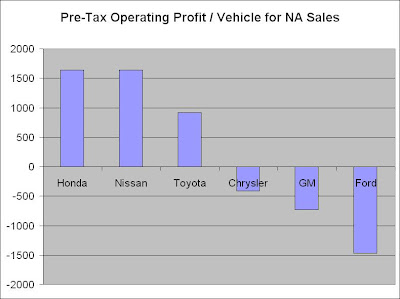
Though I talked about the $700 billion bailout in a previous post, I thought it would be prudent to discuss the second proposed bailout in as many months. This time, instead of bailing out financial institutions, Congress is debating bailing out the auto industry. More specifically, they are talking about saving the “Big Three”: GM (see below, right), Ford, and Chrysler, from potential bankruptcy. The numbers are staggering. The United States government has already passed a $25 billion relief program set to come into effect in early 2009. However, leaders at GM came out to declare that the company may run out of cash by the end of 2008, and that they would be forced to declare bankruptcy before they would be able to receive any federal aid. Thus, they came to the government asking for more money with fewer strings attached. Under the current program, the money, coming in the form of loans, would only be used to help the companies develop more fuel efficient cars. Leaders in the federal government are torn. Generally, Republicans believe that the problems American car manufacturers are experiencing are a result of their financial mismanagement and faulty business plan (see below, left). They do not believe we should bail them out, for it would be another instance of taxpayers paying for poor management of companies. Democrats claim that failure in the domestic auto manufacturing industry would be detrimental to the health of our economy and would cost Americans up to 3 million jobs. Because of how divided our government is on the issue and despite the fact that I have come to my own conclusions about the $700 billion Troubled Assets Relief Program (TARP), I decided to explore the blogosphere to get a feel for what the public and experts believe about this bailout and to leave my feedback on them. The result was overwhelming. I expected to find equal parts positive and negative feedback on the issue, but I found it hard to find any supporting commentary by economists or financial experts. Of those sites, I found two that were especially interesting. The first, “Demand More for Your Auto Bailout Dollar; Oil Patch Should Bounce Back Long Term” by Michael Fitzsimmons of Seeking Alpha, Fitzsimmons discusses what conditions the government should put on any money they give to the auto industry in order to maximize its benefit to the country as a whole. Peter Cohan, of BloggingStocks, writes about how taxpayer dollars can be best utilized to help the auto industry, and GM in particular, in a post entitled “Six Steps to Restructure GM”. Overall, I agree that the current bailout is not justified. There need to be more restrictions and covenants on the money that is being given to the auto industry. Whether that is to make the companies greener or to save taxpayers more money, it does not matter. In addition to posting my comments on the blogs, I have copied them below.

“Demand More for Your Auto Bailout Dollar; Oil Patch Should Bounce Back Long Term”
Comment:
Thank you for your thoughtful and insightful commentary on the proposed bailout of the American automobile industry. I liked how you approached the issue not as a simple yes or no to the bailout, but more of constructive commentary as to how the terms of any loans to the automobile companies can be amended to create a sustainable industry dynamic and to best benefit the country as a whole. I agree that U.S. automakers are to blame for much of the problems our economy is experiencing by producing sub-par products that increased our dependence on foreign oil and pushed consumers to foreign products. In the end, I do not believe the question is if the automobile industry will receive more money from the government. Based on its track record, the question is more when and under what terms.

I agree with your ideas that they must make a natural gas powered car and that they should strive to make cars that get over 40 MPG. That is the most sustainable approach and it also benefits every person in the country by reducing our emissions However, I do not agree that every vehicle must get over 40 MPG or that “every vehicle they make must be natural gas, hybrid, or electric”. Engines and batteries have not reached the level of technology that they are capable of being reliably installed in every vehicle. Did you forget about commercial vehicles that must be used to tow heavy loads? How can you expect vehicles like that to use a less powerful hybrid or electric engine or to achieve such a high gas mileage? Additionally, until there are better ways of getting natural gas to every consumer, it does not make sense for a large percentage of vehicles to be powered exclusively by natural gas.

Once again, thank you for taking a different approach to this issue than many other people do. It is so easy to say no without giving any sort of alternative. Hopefully, the federal government will pay attention to people like you and realize that there are better ways to approach this problem and use this money to actually improve our automobile industry rather than temporarily slow its failure.

“Six Steps to Restructure GM”
Comment:
Thank you for an interesting piece on your approach to the problems the U.S. automobile industry. I liked the fact that you took a stance that so many people have overlooked or deemed impossible, despite the fact that it is one that makes the most sense. Bankruptcy was created for companies in GM’s exact situation and it does not make sense that people cannot see that. Admittedly, we are living in a time of potentially extenuating circumstances, for the economy is in such bad shape and the stock markets so volatile that news of GM declaring for Chapter 11 protection might trigger a chain reaction that would end up destroying our economy.

The government eventually will have to put some money into the automobile industry, but not in the way it is currently planning. I think your ideas make the most sense. If people really do want to see change in companies like General Motors, then force it to declare bankruptcy and then provide the financing to restructure once it has done so. Your talking points, of merging with Chrysler, getting rid of unprofitable brands, closing related dealerships, merging Chrysler and GM brands, and cutting pay all make sense and should have been done if not for one problem that you also provide a remedy for. The management must be replaced. Your fact that GM’s CEO has “presided over a 95% decline in the company stock over his tenure” is shocking, and I agree that we cannot expect any changes if the person who started this decline remains in a position of authority.

One thing I would have liked to have seen is more talk about how to address the issue of renewable energy and increased vehicle efficiency. I agree that it may not make sense to set an immediate requirement for achieving a certain level of emissions, but does it not make sense to set some sort of timetable for requiring them to get on the right track in terms of research and development and future models?

Tuesday, November 11, 2008

The Golden Parachute: Why Current CEO Compensation in America is Unjustified

Now that the presidential election has passed and the future Commander in Chief of the United States is known, attention has shifted from the promises of change in the future to fixing the country’s deteriorating economy. One of the biggest issues that have elicited cries of outrage is the topic of CEO compensation in public companies, especially the ones that have been failing during this financial crisis. For example, Richard Fuld, former chief executive of Lehman Brothers Holdings Inc. received $484 million in compensation from 2000 until it filed for bankruptcy in September. Similar payouts have been recorded at other failed institutions like AIG and Countrywide. Considering that those individuals led their companies to failure, the question must be raised as to whether or not these CEOs are deserving of the outrageous pay packages they are given. Is it necessary to pay the top men in Corporate America tens or hundreds of millions of dollars in salary, stock, and other benefits? Additionally, is it fair that their bonus packages are often not directly linked to the performance of their company’s stock? When I started my research for this post, I was of the belief that CEO compensation in America is mostly justified, except for the extreme cases like Lehman Brothers and Countrywide. However, the more I looked into the topic, the more I came to believe the opposite. Except for certain cases where a CEO significantly increases the value of a company’s stock, the current level of pay for CEOs in America is not justified, for the amount of value they add to it is exceeded by their cost of services.

For most employees in the world, the amount of money and other benefits they are given for their work is directly correlated to their performance and the value they add to their employers. Recently in America, it seems that CEOs of large public companies have become exempt from that policy. One of the responsibilities of a CEO is to maximize value for shareholders. The problem has been that, looking at some of the highest earning CEOs in 2007, their pay is an unjustifiably large percentage of the company's earnings (see below, left). For those institutions that do link executive income to performance, they have developed too narrow of a focus on earnings. As Leo Hindery, Jr. observes in BusinessWeek, “from the end of World War II until the mid 1990s, prominent public and private company CEOs almost universally viewed their responsibilities as being equally split among shareholders, employees, customers, and the nation.” However, as time passed and companies became less regulated and their owners more greedy, shareholders became the most important. Hindery also points out that “at that point, because of the prevalence of stock option and restricted stock grants, shareholders included many if not most senior managers at a large number of publicly traded companies.” The problem that arises when the focus of a company turns towards making a profit and not towards accountability and responsibility is that encourages short-term profiteering and long-term irresponsibility, the American Federation of Labor and Congress of Industrial Organizations argues in an article entitled “Why the Mortgage Crisis Matters”. This attitude lead to the use of the complex financial instruments that produced large short-term gains, but in the end, is at the root of the credit crisis our country is suffering from right now.

In addition to being unjustified, bad for the company, and unhealthy for the economy, giving CEOs these huge salaries and stock options with even larger severance packages only grows the gap between the rich and the poor. On average, during 2007, average CEO pay was 344 times that of an average worker in the United States. Hindery points out that in other industrialized nations like Britain, Canada, and Japan, that multiple drops to 22, 20, and 11, respectively. What is it about the average CEO that makes him or her hundreds of times more important to a company than its average employee? Would the average CEO be more useful to a company than an additional 344 employees? Freek Vermeulen discusses how the boards of directors in these companies (the people who determine how much a CEO makes) use a comparison to a company’s “peer group” to justify the number they choose. Unfortunately, the problem with this logic is that the overcompensation of executives is system wide. It is a rare instance when the head of a company is not making at least upper seven digits. In reality, there are only a handful of individuals who are actually worth the kind of money CEOs are being given today. They are the Warren Buffet’s and the Jack Welch’s of the world. They are the people who, if the company were to lose them, they would potentially lose billions of dollars of value. The average CEO is not that person. He or she is skilled or intelligent, but there are many skilled and intelligent people in the world. The only difference between the two groups is that one is being paid millions and millions of dollars, while the other may be making little over what the average worker makes. I see that as a cruel injustice which polarizes our society and harms our economy. It must be changed.

Luckily, executive compensation has become a top issue in our government today. Considering the fact that the United States government is making hundreds of billions of dollars available to these companies, it absolutely should be an issue. Taxpayers should not be the ones supporting the lavish lifestyles of the people who caused the economic downturn in the first place (see right). Unfortunately, the current bailout package has loopholes in it that would allow this spending to continue unchecked, a fact which some legislators have not overlooked. They are calling for caps on CEOs salaries if they receive money from the bailout. While the bailout is a special situation, I think that there should be broader changes across the market. Stockholders, not a board of directors, should be the ones who determine how much a company’s executive makes. They are the ones who stand to make or lose money depending on how the company performs, and so they are more likely to reward smart, sustainable decisions. There may be better ways to remedy this issue, but the fact of the matter is that the amount CEOs of American companies make is excessive, and as such, is a problem. It is a detriment to the growth of a company and disease that, if allowed to continue, will keep our economy from truly regaining its health.

Tuesday, September 30, 2008

Wall Street vs. Main Street: Why the Treasury Bailout Plan Failed


Last week I wrote about the rise of socialist economics in American policy-making, citing the bailouts of Fannie Mae, Freddie Mac, and AIG as examples of this rising socialism. I also addressed the question of whether or not this marked the decline of capitalism in the United States. Since that time, there has been increasing turmoil in the financial markets as well as increased involvement by the government in the economy, most especially the proposed $700 billion bailout plan by the United States Treasury. When this plan was shot down in the House of Representatives on September 29th, it acted as a catalyst for the single largest dollar decline of the Dow Jones Industrial Average (over 777 points) as well as the Standard & Poor’s 500 Index (over 106 points) (see below, right). This reduction in stock values translated into an approximately $1.2 trillion decline in market value of the entire U.S. stock market. Considering the implications of the House of Representatives’ decision, I decided to explore various blogs to answer two questions of mine: why was the bailout plan deemed inadequate, and did the House of Representatives make the right choice in voting against it? After noting how close the vote was in the House of Representatives (228-205), I was surprised to see that most blogs agreed that the bill did not deserve to be passed. Admittedly, this is my own opinion as well, but I imagined there would be more of a counter-argument than there actually was. The question that more blogs disagreed on was why the House of Representatives decided to vote against the proposed bailout. I found two blogs that gave the most interesting insight into this decision and left my feedback on them. In the first blog, Amateur Economists, Evelyn Black addresses the issue in an entry entitled “Why Did Paulson’s Bailout Plan Fail in the Congress?” Black claims that the issues raised were the lack of regulation of CEO pay for companies that choose to receive money from the bailout plan as well as the fact that there is no guarantee the bailout would work. In the second blog, Church of the Customer, Ben McConnell briefly addresses the issue in an entry titled “Why the Bailout Package Failed.” He claims there are three main issues: the concentration of too much authority in the hands of Treasury Secretary Henry Paulson (see below, left), the lack of transparency about the administration, and, like Black, the lack of regulation of Wall Street CEO pay. For your convenience, in addition to posting my comments on their respective blogs, I have copied them below.

“Why Did Paulson’s Bailout Plan Fail in Congress?”
Comment:
Thank you for your useful insight into why Paulson’s bailout plan was voted down in the House of Representatives. It really helped to shed some light on the faults of this $700 billion piece of legislation With the market’s record-setting drop after this news was released, I think many people are wondering why exactly Congress voted against this plan and, had it been passed, whether the economy would have taken the downturn it had on Monday. Your analogy of the lobbying for this plan to an old western film is depressingly fitting, as Treasury Secretary Hank Paulson and Federal Reserve Chairman Ben Bernanke seem to be convinced that the only way to turn our economy around is by taking money out of the hands of the public and into the hands of the people who started this crisis in the first place.

I liked how you used the comments on New York Times editorials as evidence of a confrontation between Main Street and Wall Street. It adds a tangible aspect to a claim that is otherwise hard to quantify. I also liked your analysis of the analogy between this bailout plan and the Resolution Trust Corporation of 1989. I have seen the link made between the two before, especially in the context of the bailout not costing taxpayers as much as initially thought, but did not know enough about the Resolution Trust Corporation to be able to make the comparison. I agree that the comparison is not valid, for the RTC bought and sold actual assets, while this proposed bailout plan would be buying faulty financial instruments, the mortgage-backed securities.

Though I thought your blog was well researched and informative, I have some questions and comments about it. First, do you think the only reasons for the public outrage were CEO salaries? I don’t see any other reasons in the article other than the lack of a guarantee that the plan would work. Also, while you say that Congress negotiated some governmental oversight and provisions for helping homeowners keep their homes, I think this article would have benefitted by explaining those changes in more detail. The current description is relatively vague.

Thanks again for the helpful insight and I am looking forward to continuing reading your blog as the financial crisis progresses.

“Why the Bailout Package Failed”
Comment:
Thank you for your succinct article on why the bailout package failed to clear Congress. Like most people, I have been following the credit crisis closely over the past year and was especially following the progress of this bailout package. The way you opened the article with five especially gloomy headlines from a single day’s Wall Street Journal (and not even on the front page!) really painted a picture of just how dismal our economy is right now and put the entire bailout package into context perfectly.

In the body of your article, I liked how you very clearly laid out the three reasons why you believe Congress voted against the bailout. It was clear, concise, and eye-opening. I agree that the biggest issue with this bailout package was the lack of transparency in the system, especially given how much power Paulson would have been given. It is as if the government is trying to test the phrase “power corrupts, absolute power corrupts absolutely.” It was heartening to hear how the public became involved in this legislation, and I found your statistic that calls were averaging 100-1 against the bailout especially interesting. It solidified your statement that “vast numbers of citizens” were calling their representatives to reject the bailout and added credence to your argument that this financial crisis might bring about transparency in business and government.

Though I loved the article and I liked the way you started your article, I think you would have benefitted by saying what the front page headlines actually were. I understood your intentions behind what you did, but I believe it is more confusing that it has to be. Also, do you think that some of the outrage came from the fact that the government was giving money to the companies that caused this crisis rather than the people who have been hurt by it? The way you talk about rich fat-cats makes me think that you are one of the people who would rather see the money go into a stimulus package than bailing out Wall Street.

Tuesday, September 23, 2008

The Red Flag: An Examination of the Social and Economic Implications of the Recent Government Bailouts

Bailout. This one word has inspired more commentary than any other in the past few weeks. However, with every news outlet in the world talking about the bailouts of Fannie Mae, Freddie Mac, and AIG, I find it interesting how the ideological implications of these actions are only now starting to receive some attention. Most media has been focused on the direct, economic impact of Congress's decisions on the stock market now and in the near future, as well as the simple dollar figures for what the bailouts are going to cost taxpayers (see below, left). While this aspect is obviously important, there are deeper, more long-term consequences to the government’s actions. With the most recent buyouts, federal insurance for risky mortgages, economic stimulus packages, and ban on short selling of financial stocks, the government has been taking actions contrary in nature to the free market economy it was founded upon and more in line with the communist, government backed system it has been fighting against for the better part of a century. Is this the end of capitalism as we know it? Did the government take a step in the wrong direction by bailing out this country’s financial system? No, probably not. While the recent government buyouts of Fannie Mae, Freddie Mac, and AIG go against the capitalistic ideals of this country, they were necessary in order to help keep the country out of the depression it was headed towards and will eventually be seen as the right decision by the federal government. Assuming the government does not continue to take over companies or impose its will too much on the companies it already controls, these actions will be seen as temporary socialist interventions like those during the Great Depression and not the beginning of the decline of capitalism in America.

Despite the fact that most of the actions the government has taken in the recent past have be socialist in nature, the United States is not moving down a path away from capitalism; rather, it has simply been following a history of free market capitalism supported by moderately socialist government policy. Capitalism is an economic system characterized by private or corporate ownership of capital goods, by investments that are determined by private decisions and by prices, production, and the distribution of goods that are determined mainly by competition in a free market. Socialism is the opposite. It is composed of a government controlled economy in which the means of production are federally controlled. Today, the American economy cannot be accurately described by either word in itself, but more of a combination of the two. Originally, the it represented the epitome of a capitalist society. People spoke of the “American Dream,” of common men coming to the United States and working their way into fame and fortune. However, the American economy has gradually shifted away from a true free market economy towards a mix between capitalism and socialism. True, the most recent wave of attempts to revitalize the economy by the United States government have been some of the most extreme ever, but regulation of our financial markets has been a critical part of our economy since the Great Depression. In fact, one of the reasons these problems arose was the deregulation of the financial markets that allowed instruments like mortgage-backed securities to exist and subprime loans to be issued. Like it or not, the government has a history of stepping in during times of financial crisis and taking extreme measures to protect the economy (see the New Deal). For the most part, it has always been justified and ended up having a positive influence on the economy. If the United States government had not stepped in and taken the actions it did, the economic fallout would cost taxpayers much more than what it has cost to effectively bail out the housing market. According to Jeanne Sahadi, a senior writer for CNNMoney.com, “If Fannie and Freddie went under…the housing industry could seize up, causing the loss of millions of jobs.” Or, in terms of actual dollars and cents, an article by James Pethokoukis, the money and politics blogger for U.S. News & World Report, claims that the dollar cost of not bailing out Wall Street could range anywhere from $15 trillion over four years to upwards of $30 trillion. The financial markets would crash and credit markets would completely freeze, making it impossible for students to get loans and families to get mortgages. If these estimates are anywhere close to the truth, the government intervention in this financial crisis will prove to be a brilliant move that effectively saved the American economy.

There are those who argue that these bailouts set a poor example for financial institutions, especially how it guarantees money for the larger financial institutions at the expense of everyone else (see below, right). As Andrew Horowitz, founder of Horowitz & Company, says, “In a capitalistic society that relies on a free market system, we should only look to the government to guide and regulate against fraud and the manipulation of the system... it is not to be a business partner and a sugar daddy there to provide a backstop to the bad business practices of the banking system.” True, there is the potential for companies to take these bailouts as a figurative safety net for them, guaranteeing their continued existence despite any risky practices they might engage in. However, given the necessity for a dramatic move by the federal government to turn the economy around, there were not many other options. Ideally the government would not have to come in and financially back the banking system, but in times like today, people have to look past their ideals to what is the most prudent and effective solution for our financial crisis. Like the co-host of CNBC’s “Squawk on the Street” Mark Haines observed on “Morning Joe”, “Nobody really likes this on a philosophical basis, but we live in a real world and we can’t, can’t dither with philosophy when such serious matters are at stake.” Only time will tell whether or not the government made the right decision, but given the situation at the time, it made the best possible move by intervening in our failing economy. Either way, this bailout is only a temporary fix. Unless we do something about the unchecked greed that is at the root of all these problems, we will not be able to fully recover from this recession.
 
Creative Commons License
This work is licensed under a Creative Commons Attribution-Noncommercial-No Derivative Works 3.0 Unported License.